
The wild apothecary
What grows out there is more than a weed. It is a store, a home remedy, an apothecary. This section gathers the old knowledge of gathering, preserving and healing — step by step, honestly placed, to make yourself.
A permaculture garden doesn't stop at the bed. The path edge, the traditional orchard, the spruce fringe behind the fence, the corner where the nettle runs riot — it all belongs to it. You don't have to grow everything. Much of it is already there. You just have to learn to read it instead of tearing it out.
That's the idea behind the wild apothecary: a collection of articles about what people here have been bringing in from outside for generations. Free, fine things from forest and meadow. Medicinal herbs that count as weeds today. Home remedies that sat in every farmhouse drawer. None of it is complicated. Most of it needs a jar, a little patience and the willingness to look closely for once.
It's the same thinking as in the whole garden: nature has had the system for a long time. We copy it.
The four rules that stand above everything
Whichever article you take on — these four always apply:
- Only what you recognise 100 %. Not "looks like". Some edible plants have toxic lookalikes. When in doubt: leave it standing.
- Clean locations. Not by the roadside, not at the sprayed field, not on the dog-walking path.
- Never more than a third. Leave two thirds for insects, birds, other gatherers — and for next year.
- Home remedies are no substitute for a doctor. Much here is handed-down folk healing knowledge. Good for the small things of everyday life. For serious or persistent complaints: get it checked medically.
The articles
The free stuff grows outside — foraging for beginners
Dandelion capers, spruce-tip syrup, elderflower jelly. The way into gathering: what's ripe when, how to preserve it, and how to start safely.
The weed that's actually an apothecary
Ribwort as the meadow plaster, yarrow as the soldier's herb, ground elder as the gout herb of the monastery gardens. Nine plants we tear out of the bed and that stood in the herbals for centuries.
Make your own ribwort plantain cough syrup
Two methods — cold-infused or cooked — for the classic cough remedy, which grows for free at the path edge.
Pine resin salve — the wound plaster from the forest
Tree resin seals the tree's wounds. In folk medicine it has been used the same way for centuries. The simplest salve recipe of the Alpine region: three ingredients, a water bath.
Make your own herbal oils — the basis for everything
A jar, a good oil, a handful of herbs. Calendula oil, St John's wort oil & co. — and the foundation for every home-made salve.
The gathering calendar
Foraging is a calendar, not a pantry. Each thing has its window, and it's often short. This overview shows roughly when what is ripe outside (shifts by weeks depending on region and altitude):
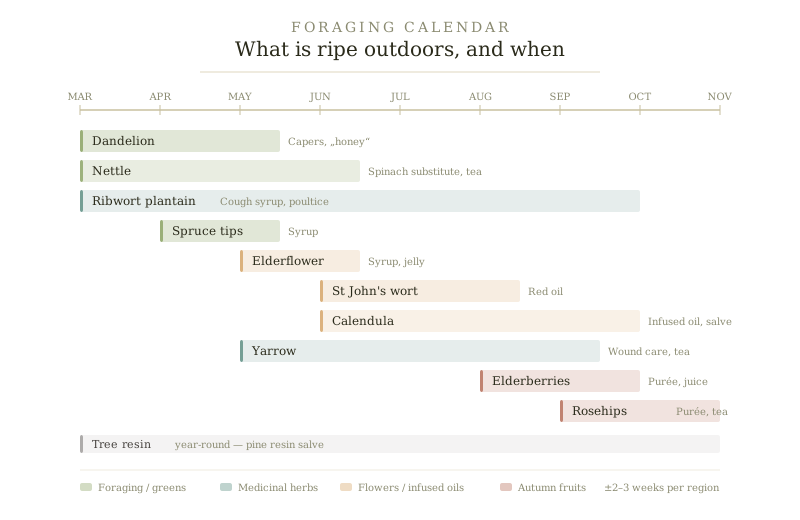
| Time | What you find | What it becomes |
|---|---|---|
| March–April | Dandelion buds, nettle (young), daisies, ribwort plantain | Capers, spinach substitute, first wound dressings |
| April–May | Dandelion flowers, spruce/fir tips, yarrow | Syrup, "honey", cough syrup |
| May–June | Elderflower, wild rose, lime, calendula, St John's wort | Syrup, jelly, herbal oils, red oil |
| June–August | Lavender, ground ivy, wild berries, medicinal herbs in flower | Massage oils, macerates, jam |
| Aug–October | Elderberries, rosehips, beechnuts, walnuts | Purée, jelly, roasted snacks, liqueur |
| Year-round | Hardened conifer resin, chickweed (mild) | Pine resin salve, winter greens |
How to start without spreading yourself thin
Do it like in the garden: not everything at once.
Learn one thing properly per season. Start in spring with dandelion capers — nothing is safer to identify, nothing goes wrong more easily. Then spruce tips in May. In summer a first herbal oil. In autumn the pine resin salve, when the resin is hanging on the tree anyway.
After a year you have a small calendar in your head that tells you what's due when. And a shelf with syrup, salve and oil on it — made from things that cost nothing but a walk.
Understand once. Use for decades.
Build your apothecary corner
Perhaps the loveliest step: instead of tearing ribwort plantain, yarrow and calendula out of the garden — let a corner go wild. The plant that comes by itself and thrives at your site is usually the toughest. You don't have to plant it. You just have to let it stand and know what it can do.
That's permaculture in practice. And it's the most direct way to bring the wild apothecary from the magazine into your own garden.
The wild apothecary is an ongoing section. The articles gather handed-down knowledge from folk and experiential healing as well as recognised phytotherapeutic uses — marked as such in each text. They are no substitute for medical advice. Only gather reliably identified plant material.
Editorial responsibility: Simon Graf, Pranarei n.e.V.
Build your complete permaculture plan in 5 minutes — with 4-year crop rotation, intercropping and climate-specific tips.
▸ To the garden planner